



Wearable Science: Turning Molecules into Meaningful Jewellery
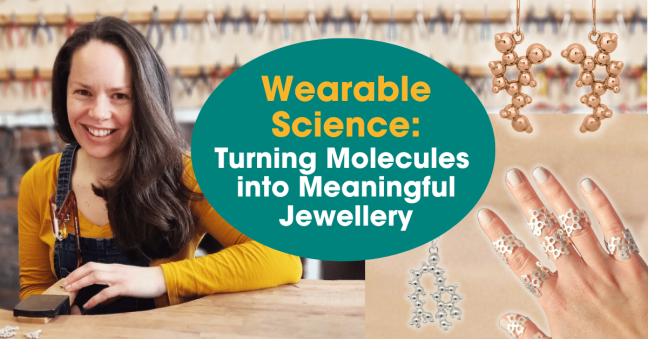
From serotonin necklaces to capsaicin earrings, jewellery maker Emily Alice has carved out a unique niche in the world of science-inspired design. Her pieces celebrate the molecules that shape our emotions, behaviours, and favourite beverages, and they’ve become hugely popular with scientists and non-scientists alike.
In this great new interview, we caught up with her to learn how she transforms complex chemical structures into accessible, eye-catching jewellery!
How long have you been creating science-themed jewellery, and what inspired you to specialise in molecules and their links to human emotion?
I’ve been making science inspired jewellery for quite a while now! I made my first piece inspired by molecules in 2001 whilst I was at university I think, but it took me a good few years after that to properly launch my collection and business. My first piece was a quite crude representation of some glucose molecules, and then I didn’t properly revisit the idea until about 5 years later. I was reading an article that was explaining the role of serotonin in our bodies, and there was an image of the molecular structure included in the article, and I knew I could work with it from a silversmithing perspective. That’s where my collection started and really snowballed from there. At the time I was living in South Korea and I had a tiny bedsit with a jewellery workbench in one corner, and I pinned that picture above my work bench and took it from there!
How do you research the molecules you feature in your designs?
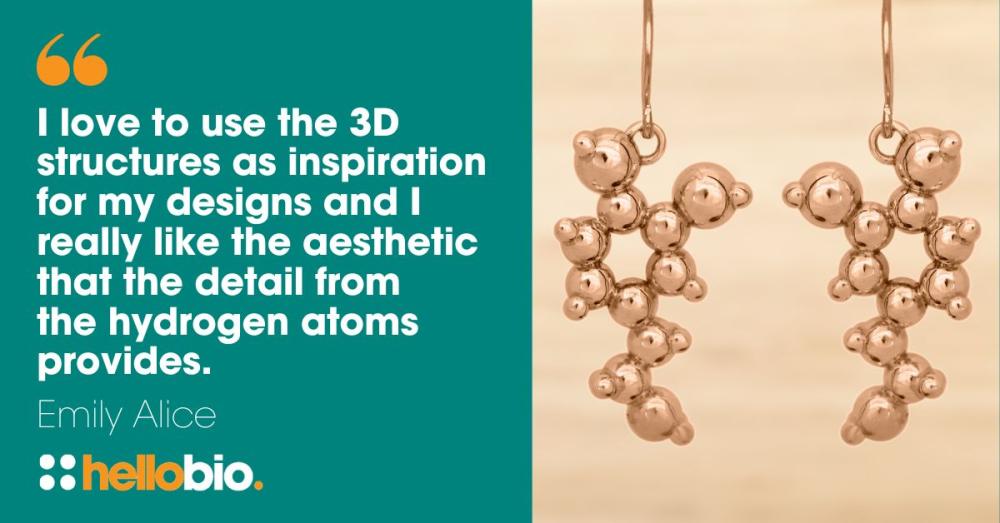
These days my first port of call is nearly always PubChem, it’s such a helpful resource for me. I love to use the 3D structures as inspiration for my designs and I really like the aesthetic that the detail from the hydrogen atoms provides. The 3D models in PubChem help me make sure I’m really representing each molecule well. Before that, if I was working on a complex commission, I’ve been known to rope in a friend who is a professor at the University of Sheffield to help me work out if I have the hydrogens in a model all correct and present over a pint, and he’s always very patient and obliging.
How challenging is it to turn a complex molecular structure into a wearable design while keeping it scientifically accurate?
Quite challenging sometimes! The most complex molecule in my collection at the moment is oxytocin. I like to show all the atoms in the structure and in this case, that includes 66 hydrogen atoms. In my jewellery design, these are shown as 66 silver balls that are each about 1.5mm.
There are certainly some pieces that I haven’t been able to create in my usual 3D way, as they are just too complex. I've been asked to create a representation of insulin many times (C256H381N65O77S6) and I usually end up making something with the text of the molecular formula on for those customers because my normal style is not possible.
Do you have a favourite molecule to work with and why? What makes it particularly meaningful or visually interesting?
Ooh, that’s tricky. They are like my children! At the moment I especially like the capsaicin molecule jewellery in my collection - I’m really happy with the way the shape worked out and it lends itself very well to a piece of jewellery. I also love my dopamine molecule collection as I’ve had so many nice stories of this being given as gifts over the years.

Do you think a customer needs a background in science to appreciate your jewellery, or does it appeal to wider audiences too? If so, what do you think gives it that appeal?
I started out with the plan to make it quite accessible to a wider audience, so many of the molecules that I use to inspire my work will be understood on some level. I can usually spot when someone comes to my stand at an exhibit or fair, and they work in the sciences, as they are often drawn to the less obvious choices (like anandamide or acetylcholine). But they definitely have a wider appeal. I like to playfully call my work ‘intellectual chic’.
Which molecules are your best sellers and why?
The top 3 are serotonin, dopamine and caffeine. I think they are probably the best known in the wider (non-science) community. Serotonin and dopamine are widely associated with happiness and excitement, and the coffee addicts can’t resist the caffeine molecule jewellery!
And finally, if you could gift one of your jewellery pieces to any scientist - living or from history - who would it be, and which molecule would you choose for them?
I think it would be Helen Fisher, and I would have chosen something from the dopamine collection. I remember watching a TED talk very early on when I was launching my molecule collection and it inspired me to really develop my idea more. Her field of research in biological anthropology really interested me and still does.
Find out more about Emily and her work:
- website: emily-alice.com
- email: hello@emily-alice.com
- Instagram: @emily_alice_jewellery
- Facebook: www.facebook.com/EmilyAliceJewelry
Join 1000s of Scientists
Be the first to hear about new product launches, free trials, special offers, and technical tips — straight to your inbox.
Subscribe to the NewsletterHigh Quality – Low Prices
By manufacturing in-house and keeping things simple, we offer savings of up to 50% compared to traditional suppliers — without compromising on quality.


